In this chapter, samples taken from the wastewater treatment plant inlet were mixed with 5 different activated carbons produced by chemical activation for 2 minutes at 150 rpm and 20 minutes at 40 rpm, and then left to stand for 60 minutes. Experiments were conducted on these prepared samples to determine Chemical Oxygen Demand (COD), pH, electrical conductivity, turbidity, and color values. Additionally, Surface Analysis and Porosity (BET), density, Fourier Transform Infrared Spectroscopy (FT-IR) analysis, and Field Emission Scanning Electron Microscopy (FE-SEM) images were interpreted. The results of this study also revealed that activation with zinc chloride is a more effective method than phosphoric acid in improving micro- and mesopore structure. These f indings once again demonstrate the critical impact of activation agents and process parameters used in activated carbon production on material properties. Furthermore, this study resulted in the conversion of waste products into more economical products, and showed that the produced activated carbons are more usable compared to commercial activated carbons.
The Interaction of Design, Material and Production Methods in 3D Printing Technologies: An Analysis of Furniture and Interior Design Elements
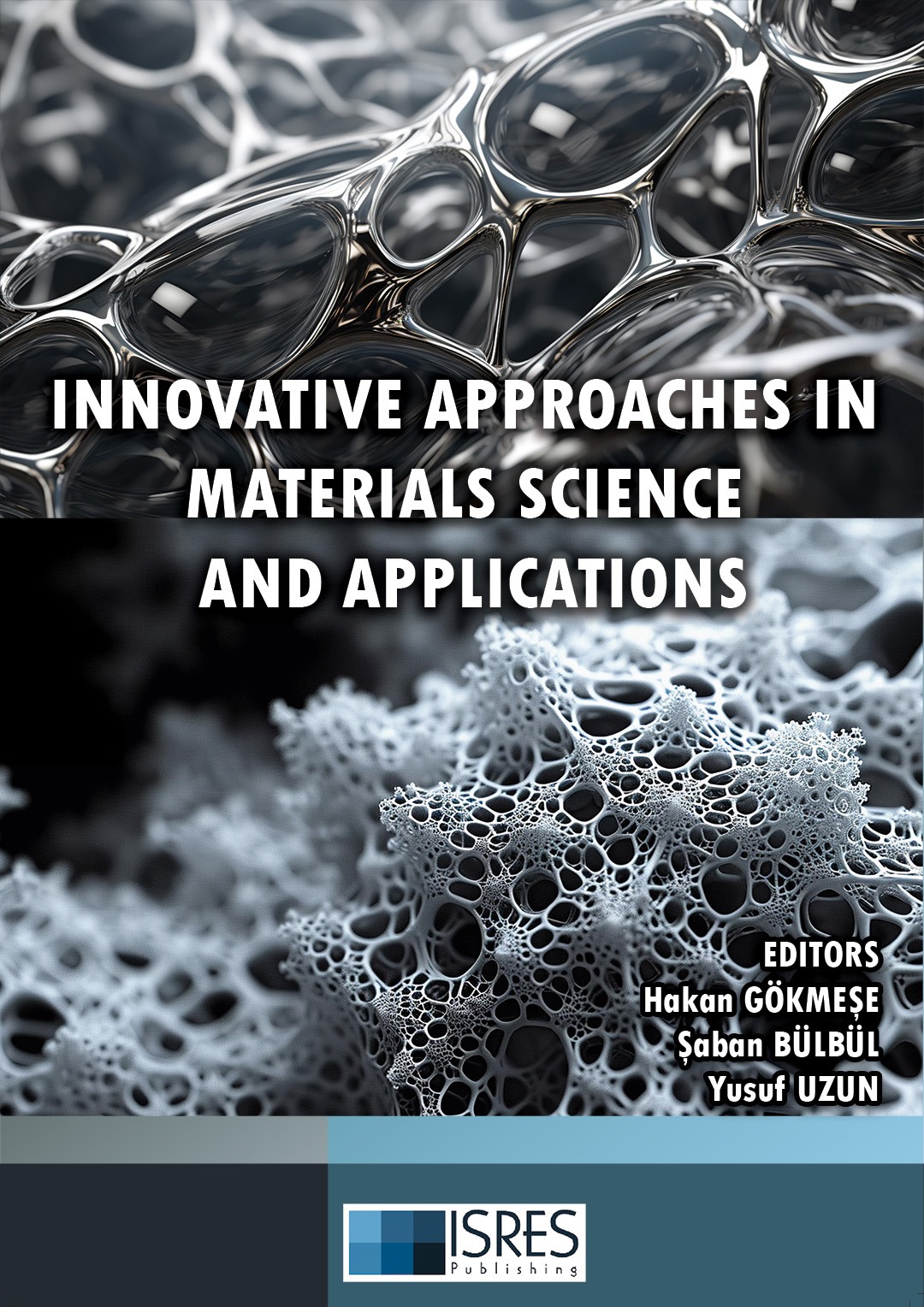
Innovative Approaches in Materials Science and Applications
Editors: Hakan GÖKMEŞE, Şaban BÜLBÜL, Yusuf UZUN
273
The Interaction of Design, Material and Production Methods in 3D Printing Technologies: An Analysis of Furniture and Interior Design Elements
Chapter Authors: Tuba ARKAN DEMİRÖRS
Pages: 18-46
Other Chapters
The Interaction of Design, Material and Production Methods in 3D Printing Technologies: An Analysis of Furniture and Interior Design Elements
Tuba ARKAN DEMİRÖRS
More Info Pages: 18-46
A Review of Activated Carbon Production and Its Characterization in the Contect of Irrigation Field Applications
Uzeyir YALMAN, Saban BULBUL, Hakan GOKMESE
More Info Pages: 1-17
Investigation of the Microstructure and Mechanical Properties of S355JR – S700MC Steels Welded by GMAW
Fatma Nur ŞAHİN, Hakan GÖKMEŞE, Şaban BÜLBÜL
More Info Pages: 47-64
Investigation of Surface Shift Behavior Under Internal Pressure In Carbon Composite Tubes
Ahmet Faruk DOĞAN, Mehmet KAYRICI, Okan KILINÇ
More Info Pages: 65-87
Advanced Exergy Analysis
Dilek Nur ÖZEN
More Info Pages: 88-103
Development of Composite Materials Reinforced with Hybrid GNP and B4 C
Melik ÇETİN, Hayrettin AHLATÇI, Kenza DJEBARI
More Info Pages: 104-127
Investigation of The Effect of Surface Hardening Process Applied to Crankshafts on Mechanical Properties
Yavuz SUN, Hayrettin AHLATÇI
More Info Pages: 128-137
Analysis of UO2+5% Cr Fuel Performance Under Normal and Accident Operating Reactor Conditions for VBER 300
Mustafa ARAT
More Info Pages: 138-151
Introduction to Composite Solid Rocket Propellants
Selva ASTAN, Ahmet Burçin BATIBAY
More Info Pages: 152-169
Characterization of Energetic Materials
Ahmet Burçin BATIBAY
More Info Pages: 170-181
Budapest/Hungary Conferences - August 28-31, 2025
We are pleased to invite you to ISRES conferences, which will be held at Obuda University/Budapest/Hungary on August, 28-31, 2025. The following conferences will be held in Budapest/Hungary:...
15.01.2025
Trabzon/Türkiye Conferences - May 01-04, 2025
ISRES Spring Conferences - Trabzon/Turkiye SOCIAL SCIENCES – May 1-4, 2025, Trabzon, Türkiye * 5th International Conference on Social Science Studies - IConSoS2025 ...
11.12.2024
Peja/Kosovo Conferences - July 10-13, 2025
We are pleased to invite you to our conferences, which will be held at University of Peja Haxhi Zeka on July, 10-13, 2025. The following conferences will be held in Peja/Kosovo: - 7th Internat...
28.11.2024



_Sayfa_001_23-12-2025.jpg)








 (1)_16-12-2024.jpg)


_29-12-2024.jpg)
 (1)_01-01-2025_10-03-2025.jpg)

_01-01-2025.jpg)